Where the Freight Disappears: Inside the Middle Mile's Quiet Cost Crisis
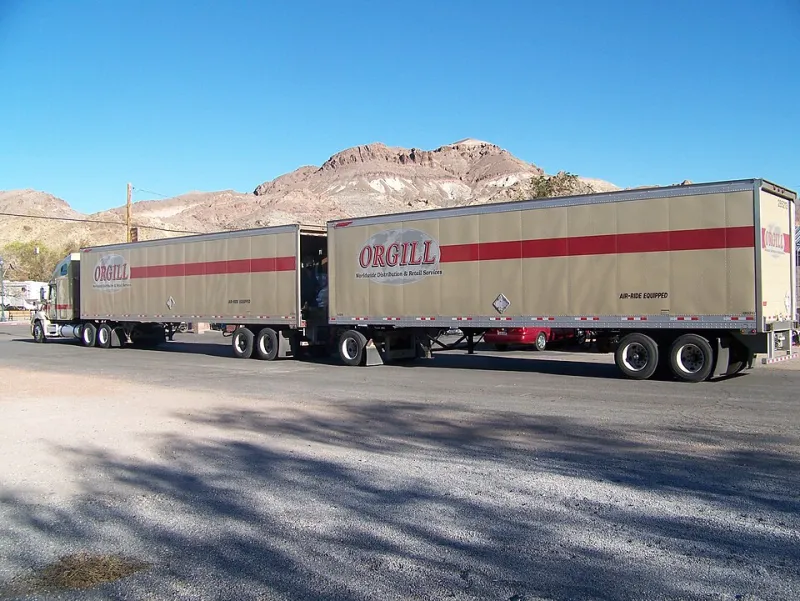
Photo: D'oh Boy (Mark Holloway) from Beatty, Nevada, USA, CC BY 2.0, via Wikimedia Commons
When supply chain leaders talk about freight spend, the conversation tends to orbit two poles: the ocean or air leg that moves goods across the Pacific, and the final delivery that determines whether a customer smiles or files a complaint. In between sits the middle mile — the drayage from the Port of Long Beach to an inland warehouse, the linehaul from a distribution hub in Columbus to a regional cross-dock in Memphis, the intermodal transfer that nobody owns end to end.
It is, by most estimates, the most expensive and least examined leg of American B2B shipping. And for many organizations, it functions as a financial black box.
The Anatomy of an Invisible Expense
Middle mile costs hide in plain sight because they're distributed. A drayage charge here, a fuel surcharge there, a detention fee buried in an accessorials invoice — individually, each line item looks defensible. Aggregated across a year, they routinely represent 30 to 50 percent of total landed transportation cost for import-heavy shippers, according to industry benchmarking studies.
Consider a typical sequence for goods entering through Savannah: container pickup, drayage to a Southeast DC, deconsolidation, linehaul to a Midwest distribution center, then transfer to regional hubs. Each handoff introduces a new carrier, a new rate structure, and a new opportunity for dwell time that nobody is billed for transparently. Detention and demurrage alone cost US shippers billions annually, and the majority of those fees trace back to middle mile friction rather than any single party's negligence.
The problem isn't that these costs are hidden from view. It's that they're hidden from accountability. No single manager owns the middle mile the way someone owns outbound parcel spend.
Why Consolidation Efforts Stall
Most large shippers have attempted some version of middle mile optimization. Few have sustained it. The reasons are structural:
- Fragmented carrier relationships. Drayage, intermodal rail, and regional linehaul are typically procured by different teams, at different times, against different criteria.
- Mode blindness. Without reliable data on transit time variance, teams default to truckload even when intermodal would serve at 15 to 25 percent lower cost on lanes over 700 miles.
- Capacity theater. Fear of service failure during peak season drives shippers to over-commit to dedicated capacity they don't fully utilize eleven months a year.
The result is a network that pays premium rates for a premium service level it rarely needs, on lanes where cheaper alternatives existed all along.
What Visibility Tools Are Actually Changing
The recent wave of supply chain visibility platforms — real-time tracking, API-based carrier connectivity, predictive ETAs — has begun to change the economics of the middle mile in one specific way: they make variance measurable.
Once a shipper can see that Lane A's transit times swing from three days to nine with no pattern, that lane becomes negotiable. Once detention events are timestamped and attributed, accessorials invoices become contestable. Several large US retailers have reported recovering seven figures annually simply by disputing detention charges with documented dwell data.
Visibility also enables something subtler: load consolidation across business units. When a company can see that its components division and its finished goods division are both running partial loads between the same Dallas and Chicago nodes, pooling becomes obvious. It was always possible; it was never visible.
A Practical Starting Point
For procurement and logistics leaders looking to interrogate their middle mile, three moves deliver the fastest return:
- Rebuild the cost picture by lane, not by carrier. Aggregate every accessorial, surcharge, and handling fee into a true cost-per-lane view. Most overpayment lives in the gap between contracted rates and actual landed cost.
- Audit dwell and detention quarterly. Attribute every hour of dwell to a responsible party and make it a standing negotiation item.
- Test intermodal on your two longest, least time-sensitive lanes. The savings on those two lanes alone typically fund the analytical effort.
The middle mile will never be glamorous. But for B2B organizations competing on margin in a low-growth economy, it has become something more valuable than glamour: the last large, unexamined pool of recoverable cost in the network.