Velocity at a Cost: The Structural Fragility Hidden Inside Your Fast-Fulfillment Strategy
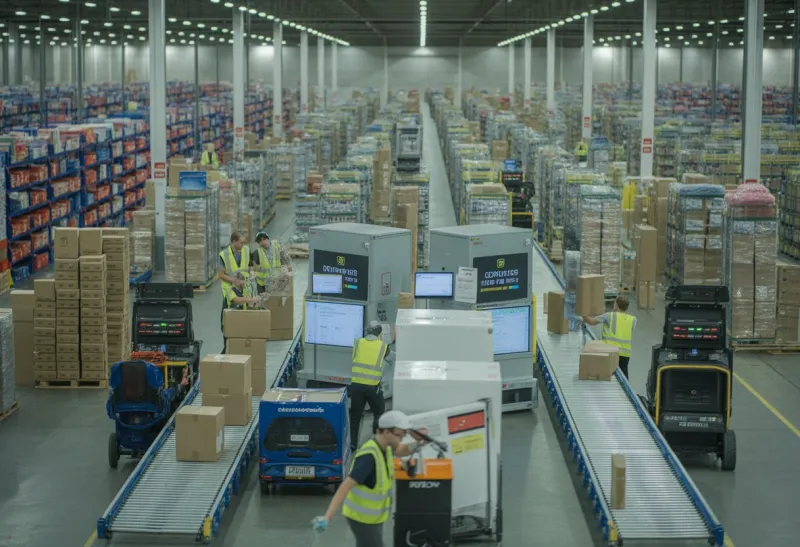
Photo: warehouse workers fulfillment center fast shipping logistics operations, via quickersameday.co.uk
Speed sells. In B2B commerce, the ability to promise and deliver shorter order-to-shipment windows has become a genuine competitive differentiator—particularly as buyers increasingly import consumer-market expectations into their professional purchasing decisions. The pressure to compress fulfillment timelines is real, and the companies that have responded effectively have earned meaningful advantages in customer retention and wallet share.
But speed is not free. The cost is rarely listed on the balance sheet, and it does not appear in the fulfillment metrics that procurement and logistics teams typically track. It accumulates instead in the structural configuration of the supply chain itself—in the redundancy that gets stripped away, the buffer capacity that gets eliminated, and the risk mitigation mechanisms that get deprioritized in the pursuit of faster cycle times.
This is what might be called the speed tax: a set of hidden liabilities that accumulate as organizations optimize aggressively for velocity.
How the Trade-Off Gets Made—and Missed
The business case for faster fulfillment is typically constructed around customer satisfaction metrics, contract win rates, and competitive positioning. These are legitimate considerations, and the data supporting faster delivery as a commercial advantage is well established. What the business case rarely models with equal rigor is the supply chain architecture required to sustain the promised performance.
Meeting tighter fulfillment windows generally requires one or more of the following: positioning inventory closer to demand points, reducing order batching in favor of more frequent smaller replenishments, or working with suppliers capable of processing and shipping orders on compressed timelines. Each of these requirements, pursued to its logical conclusion, introduces vulnerabilities.
Inventory positioned closer to demand points typically means a more distributed network with higher carrying costs and reduced pooling efficiency. More frequent, smaller replenishments increase transaction volume and logistics costs while also concentrating demand on a narrower set of high-performing suppliers. Reliance on suppliers with the operational capability to execute fast-turn orders often means a smaller, more specialized supplier base—which reduces redundancy.
The result is a supply chain that performs impressively under normal conditions and becomes acutely exposed when conditions shift.
The Redundancy Problem
Redundancy—the capacity to absorb disruption through alternative sources, buffer inventory, or flexible routing—is the structural foundation of supply chain resilience. It is also, by definition, inefficient. Redundant capacity sits idle most of the time. Backup suppliers receive limited volume. Safety stock occupies warehouse space and ties up working capital.
Organizations optimizing aggressively for speed face relentless pressure to eliminate this apparent inefficiency. Lean inventory practices, just-in-time replenishment, and single-source supplier consolidation all reduce the friction in a supply chain operating under normal conditions. They also reduce the chain's ability to absorb shocks.
The 2021 supply chain disruptions that rippled across virtually every sector of the US economy offered a vivid illustration of this dynamic. Companies that had consolidated to fewer, faster suppliers found themselves with limited alternatives when those suppliers encountered capacity constraints. Those that had reduced safety stock to minimize carrying costs faced extended stockouts. The speed-optimized supply chains that had looked like competitive advantages in 2019 became structural liabilities in 2021.
The lesson was not that speed optimization is inherently wrong. It is that the resilience cost of speed optimization is frequently underestimated and underweighted in strategic planning.
The Concentration Effect
Fast fulfillment also creates a concentration dynamic that deserves closer scrutiny. When a business commits to aggressive delivery windows, it gravitates toward suppliers that can reliably meet those windows. Over time, volume concentrates with a smaller set of high-performing partners. Secondary suppliers, unable to match the cycle times of the primary network, receive declining order share and eventually lose the operational familiarity and capacity allocation that would make them viable backups.
This is the quiet mechanism by which speed optimization erodes supplier diversity. It is not a deliberate strategic choice—it is an emergent consequence of optimizing fulfillment performance metrics without accounting for network resilience metrics. The supply chain becomes faster and more fragile simultaneously, and the fragility is largely invisible until a disruption makes it apparent.
Rethinking the Fulfillment Calculus
None of this argues for abandoning speed as a strategic priority. Competitive delivery windows matter, and the businesses that cannot meet market expectations for fulfillment performance will face real commercial consequences. The argument, rather, is for a more complete accounting of what fast fulfillment actually costs—and a more deliberate approach to managing the trade-offs.
This begins with distinguishing between speed requirements that are genuinely driven by customer demand and those that reflect internal assumptions about competitive positioning. Not every SKU, every customer segment, or every order type requires the same fulfillment velocity. Segmenting the fulfillment strategy—applying fast-turn capabilities where they generate measurable commercial value and preserving resilience-oriented practices elsewhere—is a more sustainable approach than applying a uniform speed standard across the entire supply chain.
It also requires treating resilience as a design parameter rather than an afterthought. When evaluating the cost of maintaining a secondary supplier relationship or carrying additional safety stock in a critical category, the relevant comparison is not the carrying cost in a stable environment—it is the cost of the disruption that redundancy would prevent or mitigate.
Measuring the Right Things
Perhaps the most important operational change is in how fulfillment performance is measured. Most organizations track order-to-shipment cycle times, on-time delivery rates, and customer satisfaction scores. Fewer track the resilience metrics that would reveal whether the supply chain is becoming more fragile as it becomes faster: supplier concentration ratios, backup supplier activation readiness, safety stock coverage by category, and scenario-tested response capacity.
Building these metrics into operational dashboards does not slow down a supply chain. It provides the visibility needed to make informed decisions about where speed optimization is sustainable and where it is quietly accumulating risk.
The supply chains that will perform most consistently over a multi-year horizon are not the fastest ones. They are the ones that have made deliberate, well-informed choices about the speed they can sustain without compromising the structural integrity that makes sustained performance possible.