The Supplier You Trust and the Network You've Never Seen: Closing the Last-Mile Visibility Gap
There is a moment familiar to procurement professionals across every industry: a shipment arrives late, damaged, or short — and the supplier's response is a shrug accompanied by a vague reference to a carrier issue. The apology is sincere. The explanation is incomplete. And somewhere between your supplier's loading dock and your receiving bay, accountability quietly dissolved.
This is not an isolated failure of vendor performance. It is a structural feature of how modern B2B fulfillment actually works — and most buying organizations have built their planning assumptions around a version of the supply chain that no longer exists.
What Your Contract Covers and What It Doesn't
The typical B2B supplier agreement is a detailed document. It specifies product specifications, lead times, quality standards, and escalation procedures. What it rarely addresses is how the supplier intends to physically move goods from their facility to yours — and who, precisely, will be doing the moving.
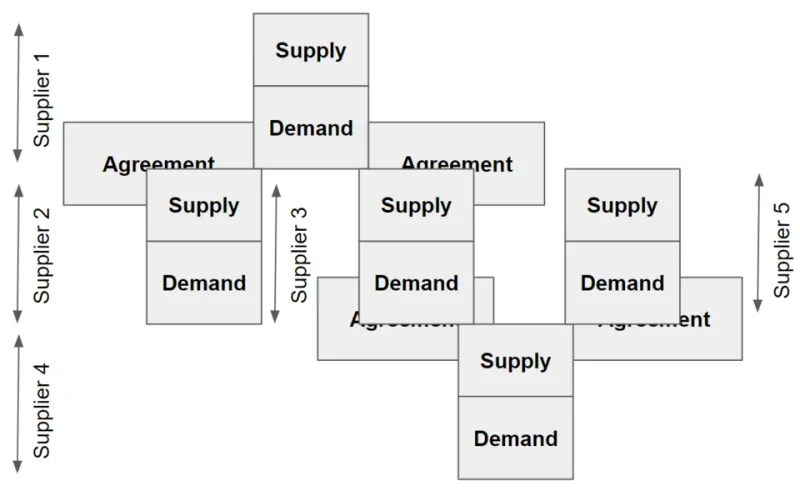
In practice, a significant share of supplier fulfillment is executed through subcontracted networks. A manufacturer in the Midwest may hand off finished goods to a regional 3PL. That 3PL may further broker final delivery to an asset-light carrier operating in your metro area. Each handoff represents a node in the network — and each node is functionally invisible to your planning team.
The result is a phenomenon that supply chain professionals are beginning to call the "phantom handoff": the point at which your contracted supplier's responsibility effectively ends, even though your contractual expectations have not.
The Planning Assumptions That Break Down First
Lead time calculations are the first casualty. When procurement teams model reorder points and safety stock levels, they typically anchor those figures to historical performance data from their direct supplier relationship. But if that supplier's last-mile execution is handled by a rotating cast of subcontracted carriers — each with their own capacity constraints, routing logic, and service levels — the historical data becomes unreliable as a forward-looking input.
Quality assurance is the second failure point. Chain-of-custody documentation is frequently incomplete across subcontracted fulfillment tiers. Temperature excursions, improper handling, and storage condition violations that occur outside the primary supplier's facility are difficult to trace and nearly impossible to attribute with precision. By the time a claim is filed, the evidence trail has gone cold.
Inventory visibility is the third dimension of exposure. Without real-time status updates from every node in the fulfillment chain, buying organizations cannot distinguish between goods that are in transit, goods that are staged at an intermediate facility, and goods that have been misrouted entirely. That ambiguity cascades directly into inaccurate available-to-promise figures and missed customer commitments.
How Leading Buyers Are Responding
Forward-thinking procurement and logistics teams are not waiting for suppliers to voluntarily disclose their fulfillment subcontracting arrangements. They are building that disclosure into the sourcing and onboarding process itself.
The most effective approaches share several common elements.
Mandatory logistics network disclosure. Progressive supplier agreements now include provisions requiring vendors to identify every third-party logistics partner involved in fulfillment — including carriers, warehouse operators, cross-dock facilities, and final-mile delivery providers. This disclosure is treated as a material contract requirement, not an administrative formality.
Tiered visibility standards. Rather than applying uniform tracking requirements to all suppliers, leading organizations are segmenting their vendor base by criticality and applying proportional visibility standards. High-volume or time-sensitive supply relationships warrant GPS-level shipment tracking and automated exception alerts. Lower-risk relationships may require only periodic status reporting at key transit milestones.
Supplier logistics audits. Some organizations have extended their supplier qualification programs to include structured assessments of logistics subcontractors. These audits evaluate carrier financial stability, safety compliance records, technology integration capabilities, and service level consistency — the same criteria applied to primary suppliers, extended one layer deeper into the network.
Contractual flow-down provisions. Sophisticated procurement teams are inserting flow-down language into supplier agreements that requires vendors to impose equivalent performance and visibility standards on their own logistics subcontractors. This creates contractual continuity across fulfillment tiers without requiring the buyer to establish direct relationships with every subcontractor.
The Technology Infrastructure Behind Effective Visibility
Audits and contract language establish the framework. Technology closes the operational gap.
Supply chain visibility platforms that aggregate tracking data from multiple carrier systems — including less-than-truckload networks, regional parcel carriers, and intermodal operators — give procurement and logistics teams a consolidated view of in-transit inventory regardless of which subcontractor is physically moving it. When integrated with ERP and inventory management systems, these platforms can trigger automated reorder actions or escalation workflows the moment a shipment falls outside expected parameters.
Electronic data interchange standards, while imperfect, remain the baseline for exchanging shipment status information across carrier networks. Organizations that have invested in modernizing their EDI infrastructure — or migrating toward API-based data exchange — are better positioned to capture real-time status from a broader range of logistics partners, including smaller regional carriers that may not support legacy integration formats.
For B2B buyers operating through digital commerce platforms, the expectation of end-to-end order visibility has become a baseline requirement rather than a differentiator. Suppliers who cannot provide that visibility — or whose logistics subcontractors cannot support it — are increasingly finding themselves at a competitive disadvantage during vendor selection.
Reframing the Supplier Relationship
The deeper shift required here is conceptual. B2B buyers have long evaluated suppliers as discrete entities — assessing their financial health, production capacity, quality systems, and commercial terms in relative isolation. But the operational reality is that every supplier is the front end of a network, and the performance delivered to your dock reflects the cumulative capability of every node in that network.
Accepting that reality means extending supplier intelligence practices beyond the primary vendor relationship. It means asking harder questions during RFP processes — not just "what is your lead time?" but "who executes your final-mile delivery, and what visibility do they provide?" It means treating logistics subcontracting disclosure as a risk management input, not a procurement afterthought.
Organizations that make this shift will find that many of the delivery failures they have historically attributed to supplier underperformance are actually logistics network failures — problems that, once properly identified, can be addressed through targeted carrier qualification, route optimization, or strategic warehousing adjustments.
The phantom handoff does not have to remain invisible. But making it visible requires deliberate action — in contract design, in supplier qualification, and in the technology infrastructure that connects your planning systems to the physical movement of goods. The supply chains that perform reliably under pressure are the ones where every node in the network is known, monitored, and held to account.